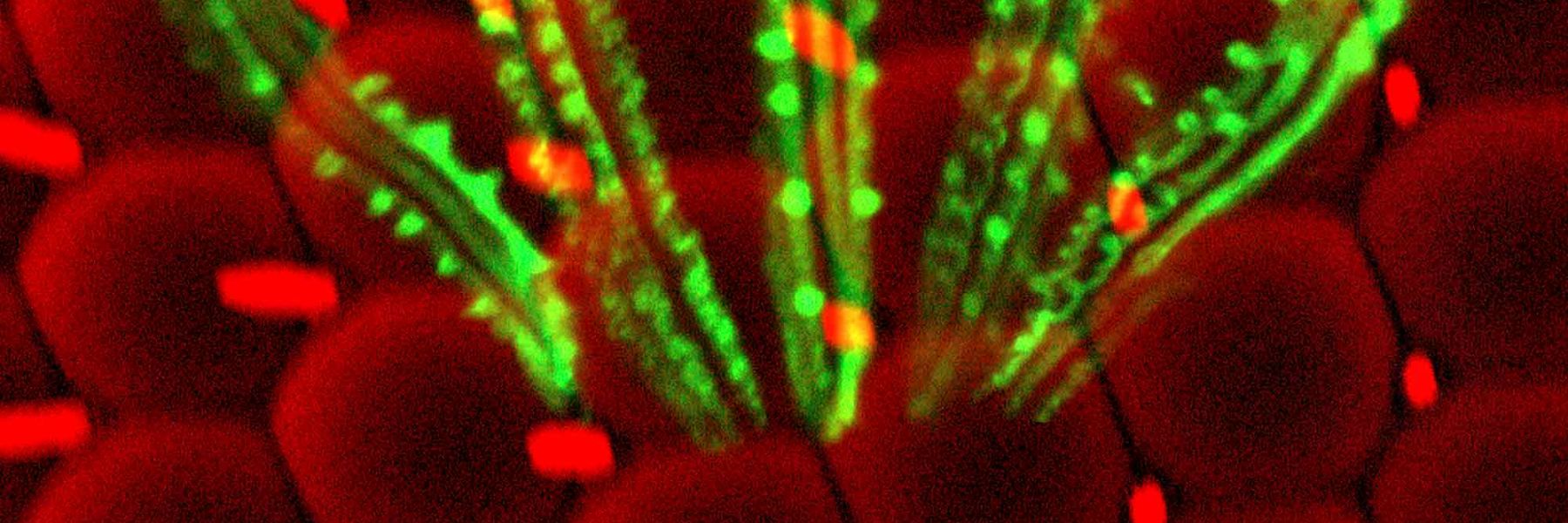
Cell biology faculty members in MCDB investigate the structure and function of cells and how cellular activity couples external/internal signals to various physiological and pathological events. Current research topics include microtubule dynamics, membrane trafficking, protein/lipid glycosylation, cell adhesion/migration, cell polarity, cell signaling, fertilization, cell differentiation, tumorigenesis/cancer metastasis, programmed cell death, mRNA translocation/local protein synthesis, and pathogen-host interaction. Investigators employ a wide variety of model systems ranging from unicellular eukaryotes and cultured cells, to flies, worms, plants, and animals, bringing together a myriad of scientific approaches including molecular biology, biochemistry, genetics, physiology, microscopy, computer modeling, and nanotechnology. These combined areas of expertise create a stimulating and rich integrative research environment. Moreover, active collaborations among different research groups generate a more extensive and synergistic output.

Human stem cell research; Molecular mechanisms of stem cell differentiation; Derivation of ocular cells from stem cells; Soft tissue regeneration.
Molecular cell biology of plant-microbe symbiosis, structure and function of plant cell walls, bioinformatics of tandem repeat proteins.
Molecular mechanisms of self/non-self recognition in non-vertebrates; characterization of stem cells and development processes underlying regeneration and aging.
Biochemistry and Cell Biology of Neuronal Development; Biochemistry of Neurodegenerative Diseases; Structure, Function and Regulation of the Microtubule Associated Protein, Tau; Cytoskeletal Regulation.
Structure and function in the vertebrate retina with an emphasis on mechanisms underlying photoreceptor degeneration and the role of glial cells in normal and injured or diseased retina.
Cellular and molecular basis of fertilization, egg activation and the egg-to-embryo transition using a variety of marine invertebrates.
Neural plasticity including the molecular basis of plasticity, the evolution of synapses, and disease-related impairments of plasticity such as occurs in Alzheimer's disease.
Molecular mechanisms of signal transduction; Alzheimer's Disease and other protein aggregation/misfolding diseases; molecular biology, enzymology, and protein structure/function.
Nanomedicine in Biomedical Discovery, Diagnosis, and Therapeutics that Target the Molecular and Cellular Origins of Disease.
Tetrahymena genetics and genomics; genetic, physical and sequence mapping of the germline and expressed genomes of the unicellular eukaryote, Tetrahymena thermophila.
Molecular genetics of Drosophila development, focusing on genes with dominant misexpression phenotypes in adult bristles. Bioinformatic analyses of contact-dependent growth inhibition systems in diverse bacterial species.
Molecular and genetic control of development in the nematode C. elegans; regulation of programmed cell death; mechanisms of tumorigenesis.
Cell adhesion and tumor metastasis; study of molecular signatures in vessels, and the use of these vascular "zip codes" in targeted drug delivery.
Cell biology of the nervous system and muscle. Mechanisms of ion channel trafficking; function and regulation of potassium channels; polarized targeting of membrane proteins and neuronal cell polarity.
Investigation of molecular mechanisms underlying polycystic kidney disease (PKD) and related renal diseases. Membrane trafficking and epithelial cell polarity.
Mechanism and regulation of microtubule polymerization and dynamics; mechanism of action of microtubule-targeted anticancer drugs and microtubule-regulatory proteins.
Molecular, Cellular, and Developmental Biology •
University of California, Santa Barbara
Copyright © 2012 The Regents of the University of California, All Rights Reserved.
Site Information •
Terms of Use •
Privacy •
Login