
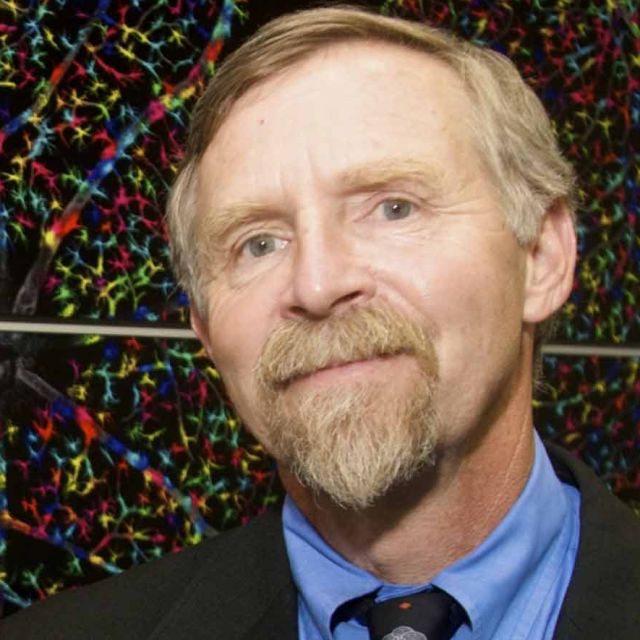
Dennis Clegg
Related Links
Biography
Dr. Clegg earned his BS degree in biochemistry at UC Davis and his PhD in biochemistry at UC Berkeley, where he used emerging methods in recombinant DNA to study the sensory transduction systems of bacteria. As a Jane Coffin Childs Postdoctoral Scholar at UCSF, he studied neural development and regeneration. He has continued this avenue of research since joining the UCSB faculty, with studies of extracellular matrix and integrin function in the developing eye. His current emphasis is in stem cell research, with a focus on developing therapies for ocular disease. Dr. Clegg is the recipient of the UCSB Distinguished Teaching Award in the Physical Sciences, the Pacific Coast Business Times Champions in Health Care Award, the National Eye Institute Audacious Goals award, and served as Chair of the Department of Molecular, Cellular and Developmental Biology from 2004-2009. He has been a Frontiers of Vision Research Lecturer at the National Eye Institute, a Keynote Lecturer at the Stem Cells World Congress, and a TEDx speaker. He is founder and Co-Director of the UCSB Center for Stem Cell Biology and Engineering, and has served on advisory boards for the California Institute for Regenerative Medicine and the National Institutes of Health Center for Regenerative Medicine. He is a Co-Principal Investigator of The California Project to Cure Blindness, a multi-disciplinary effort to develop a stem cell therapy for Age-Related Macular Degeneration.
Research
How does something as complex, beautiful, and functional as an eye develop? How do neurons become precisely aligned and connected in intricate networks that allow vision and thought? And what goes awry in the case of neurodegenerative diseases? Finally, can stem cells be applied in novel therapies to treat such diseases, especially age-related macular degeneration? These are the principal questions that drive our current efforts in human stem cell research, as part of the UCSB Center for Stem Cell Biology and Engineering.
Derivation of Ocular Cells from Stem Cells
Embryonic, induced pluripotent (iPS), and adult stem cells have great potential for treating a variety of diseases, including eye maladies such as macular degeneration. We have begun studies aimed at understanding the basic biology of how stem cells differentiate into ocular cells, especially retinal pigmented epithelium (RPE). The RPE forms a pigmented monolayer behind the retina, and functions to nourish rod and cone photoreceptors. RPE are of particular interest because their death leads to blindness. Loss of RPE is thought to be the first event in age-related macular degeneration, the leading cause of blindness in the elderly. There is great interest in using stem cell-derived RPE to treat this and other ocular diseases. We have recently shown for the first time that RPE differentiated from iPS cells can rescue vision in a rat model of retinal dystrophy. Furthermore, we found that RPE could be reprogrammed to iPS cells, and that some lines retained a memory of their origin and tended to spontaneously redifferentiate into RPE. We are currently investigating the molecular basis of this example of epigenetic memory.
While there are many significant challenges to overcome in developing stem cell-based therapies, the eye has certain advantages. Ocular tissues are well understood, easily accessible, and can be imaged noninvasively. Furthermore, relatively few transplanted cells are likely to be needed compared to other sites in the body. Finally, there are many excellent ophthalmological tests that are available to assess outcomes. With funding from the California Institute for Regenerative Medicine, we are working with a "Disease Team" of investigators from USC, Caltech, City of Hope, University College, London, and Geron, Inc, ranging from basic to clinical, to develop a stem cell-based therapy for Age-Related Macular Degeneration. We have developed protocols to generate very pure cultures of RPE, which we have analyzed using a broad arsenal of molecular and cellular assays. Working with other team members, we have devised a synthetic scaffold to support these cells after transplant. Our goal is to develop a combination of cells and scaffold that can be implanted in patients in a simple, outpatient procedure.
Soft Tissue Regeneration
Many diseases and injuries involve loss of soft tissue, and current methods of fat grafting are often not adequate. The richest source of adult stem cells is adipose tissue, and we are investigating adult human adipose stem cells, which might have applications in soft tissue regeneration. We are engaged in interdisciplinary collaborations with materials scientists to engineer synthetic matrix for stem cell growth and differentiation. Novel, bio-mimetic substrates are being designed to stimulate stem cell integrin receptors that signal to bring about cell survival, proliferation, and/or differentiation.
Selected Publications
Pennington, B.O., Clegg, D.O., Melkoumian, Z.K., and Hikita, S.T. (2015) Defined culture of human embryonic stem cells and xeno-free derivation of retinal pigmented epithelial cells on a novel, synthetic substrate. Stem Cells Translational Medicine, 4:165-77.
Huang, X., Hu, Q., Braun, G.B., Pallaoro, A., Morales, D.P., Zasadzinski, J., Clegg, D.O., and Reich, N.O. (2015) Light-activated RNA interference in human embryonic stem cells. Biomaterials, 63:70-79.
Zhao, T., Zhang, Z.N., Westenskow, P.D., Todorova, D., Hu, Z., Lin, T., Rong, Z., Kim, J., He, J., Wang, M., Clegg, D.O., Yang, Y.G., Zhang, K., Friedlander, M. and Xu, Y. (2015) Humanized mice reveal differential immunogenicity of cells derived from autologous induced pluripotent stem cells. Cell Stem Cell, 17:353-9.
Clevenger, T.N., Hinman, C.R., Ashley Rubin, R.K., Smither, K., Burke, D.J., Hawker, C.J., Messina, D., Van Epps, D., Clegg, D.O. (2016) Vitronectin-Based, Biomimetic Encapsulating Hydrogel Scaffolds Support Adipogenesis of Adipose Stem Cells. Tissue Eng Part A, 22:597-609.
Brant Fernandes R.A., Koss M.J., Falabella P., Stefanini F.R., Maia M., Diniz B., Ribeiro R., Hu Y., Hinton D., Clegg D.O., Chader G, Humayun MS. (2016) An Innovative Surgical Technique for Subretinal Transplantation of Human Embryonic Stem Cell-Derived Retinal Pigmented Epithelium in Yucatan Mini Pigs: Preliminary Results. Ophthalmic Surg. Lasers Imaging Retina, 47:342-51.
Thomas, B.B., Zhu, D., Zhang, L., Thomas, P.B., Hu, Y., Nazari, H., Steffani, F., Falebella, P., Clegg, D.O., Hinton, D.R., Humayun, M.S. (2016) Survival and Functionality of hESC Derived Retinal Pigment Epithelium Cells Cultured as a Monolayer on Polymer Substrates Transplanted in RCS Rats, Invest. Ophthalmol. Vis. Sci., 57:2877-2897.
Leach, L.L., Croze, R.H., Hu, Q., Nadar, V.P., Clevenger, T.N., Gamm, D.M. and Clegg, D.O. (2016) Induced pluripotent stem cell-derived retinal pigmented epithelium: A comparative study between cell lines and differentiation methods, Journal of Ocular Pharmacology and Therapeutics, 32:317-30.
Koss, M.J., Falabella, P., Stefanini, F.R., Pfister, M., Chader, G.J., Thomas, B.B., Thomas, P., Kashani, A.H., Brant, R., Hikita, S.T., Johnson, L.V., Clegg, D.O., Zhu, D., Hinton, D.R., Humayun, M.S., (2016). Subretinal implantation of a monolayer of human embryonic stem cell-derived retinal pigment epithelium: a feasibility and safety study in Yucatán minipigs, Graefe’s Archive for Clinical and Experimental Ophthalmology, 254:1553-65.
Clevenger, T.N., Luna, G., Boctor, D., Fisher, S.K., and Clegg, D.O. (2016) Cell-mediated remodeling of biomimetic encapsulating hydrogels triggered by adipogenic differentiation of adipose stem cells. Journal of Tissue Engineering, 7:1-12.
Huang, X., Hu, Q., Lai, Y., Morales, D.P., Clegg, D.O., Reich, N.O. (2016) Light-patterned cell-resolution RNA interference of 3D-cultured human embryonic stem cells, Advanced Materials, 28:10732-10737.
Croze, R.H., Thi, W.J., and Clegg, D.O. (2016) ROCK Inhibition Promotes Attachment, Proliferation and Wound Closure in Human Embryonic Stem Cell Derived Retinal Pigmented Epithelium, Translational Vision Science and Technology, 5:1-13.
Pennington, B.O. and Clegg, D.O. (2016) “Pluripotent stem cell-based therapies in combination with substrate for the treatment of age-related macular degeneration. Journal of Ocular Pharmacology and Therapeutics, 32:261-71.
Clegg, D.O. (2016), Regenerating Perfection, Journal of Ocular Pharmacology and Therapeutics, 32(5):237.
Clevenger, T.N., Luna, G., Fisher, S.K. and Clegg, D.O. (2016) Strategies for bio-engineered scaffolds that support adipose stem cells in regenerative therapies. Regenerative Medicine: 11:589-99.

